
Business security is a continually evolving field of technology. With each advancement in the industry comes a new way to keep data, inventory, property, employees and customers as safe as possible.
Access control technology is one such advancement. Access control allows only certain people into specific areas by verifying someone’s identity via PIN, keycard, biometric reader or other means.
Access control can improve security in any number of ways. For example, your business could utilize access control to let employees into the office building through a particular entrance, or restrict data storage rooms to managers.
Especially in the era of COVID-19, companies are actively seeking ways to limit contact with shared surfaces, such as doorknobs. As you’ll see, many types of access control enable touchless entry, which can improve hygiene and limit germ transfer.
Read on to discover the many types of access control available and how they can enhance business security.
Perhaps you feel apprehensive about installing access control, especially if you already have other business security components in place. However, access control offers unique, powerful insights for your business.
Along with added protection, access control also improves operating efficiency and security in the following ways:
Not only can you control who can enter particular areas of your business, you can gain data that can be useful to your operations. Keeping a log of who is entering certain parts of your building and when has many practical applications.
There may also be many more applications specific to your industry and your company’s particular functions. As you learn about the different types of access control available, you may discover additional applications for this technology.
As mentioned, there are varied kinds of access control available on the market. The best way to start narrowing down options for your business is to learn as much as possible about what’s out there. Use this list as a starting point.
An intercom system allows users to communicate back and forth using two-way voice communication. Visitors or employees can be granted access once audio verification takes place.
This type of access control is simple to use and install. However, it requires an employee to be present for listening and granting access to anyone on the other side of the entrance.
An intercom system may make it easier to gain unauthorized access if the employee on the other side of the intercom can’t discern slightly different voices. This type of access control might be better suited when paired with another type of business security, like security cameras, for added assurance of who’s really at the door.
Turnstile readers are another simple form of access control. They are usually waist-high, but can also be full gates, and they grant access when a card or fob with the correct credentials is presented.
While not incredibly technologically advanced, turnstiles elevate security because they’re designed to only allow one person through at a time. Unlike a door, turnstiles make it nearly impossible for multiple people to pass through using one person’s access control credentials.
For this reason, they are helpful for people counting.
Be aware that many standard turnstyles aren’t accessible for people carrying large items, like a vendor with a stack of boxes; nor are they typically ADA compliant. If you choose turnstiles as your primary form of access control, include a specially developed barrier for these situations.
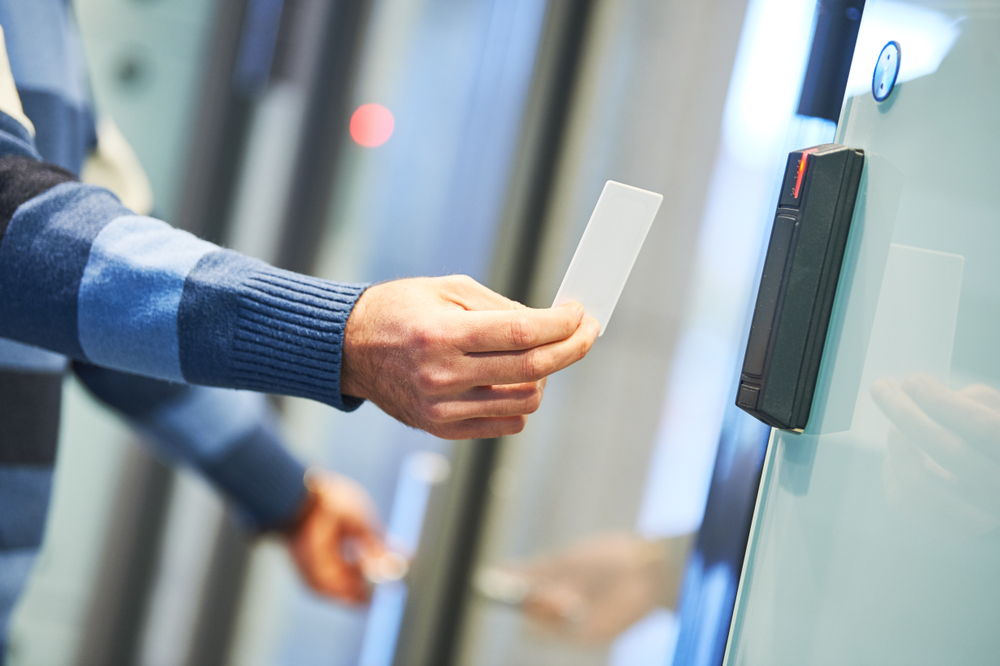
Swipe readers work by granting access when an employee swipes a card or fob through a sensor. This type of technology allows you to program unique credentials for each user, so every person’s fob or swipe card is unique to them.
Swipe readers allow for simple system maintenance if someone loses a fob or card, or leaves the company—it’s much easier to adjust your security system’s digital settings and render a fob useless than it is to rekey a building.
However, there is up-front cost and labor associated with obtaining and distributing the proper fobs to everyone in your organization.
You may choose to pair your swipe cards with a photo identification component. Photo identification simply enhances your employees’ cards with a photo of them, which allows security personnel to provide visual confirmation of the person seeking access.
This limits the ability for someone to use another person’s card to gain unauthorized access when their appearance doesn’t match the photo on the card.
Proximity readers are similar to swipe readers in that they require cards or fobs that when detected by a reader, allow entry into certain areas of your business.
However, proximity readers are a step more technologically advanced in that they grant access with a wave in front of a reader, as opposed to requiring employees to manually swipe the magnetic strip of a card or a fob through a reader.
Depending on the type of reader you install, you can have more control over how close an employee’s fob or card must be to the reader to gain access. Your employees may only need to step into a doorway with their fob on their person for the door to unlock or automatically open.
Combination technology readers combine keypads with card-reading technology and are designed for higher security installations. This dual method of identification—a PIN number for the keypad and a unique card or fob—makes it more difficult for someone to gain unauthorized entry.
Examples of areas where you may require a high-security access control method include granting access to spaces that:
Biometric readers enable entry based on an individual’s physical attributes, such as facial recognition, fingerprints, hand geometry, retinal scans or voice recognition.
And, in the wake of COVID-19, some employers even use biometric access control in the form of thermal imaging systems to measure an employee’s temperature before granting them entry to the building. A high temperature could be an indicator of a highly infectious COVID-19 infection, so this is yet another way to keep your employees safe.
Physical attribute identification makes false authentication more difficult than with other types of access control. For example, iris and retinal recognition technology works by scanning the unique colors, designs and blood vessel patterns within a person’s eye. This level of scrutiny makes it much more difficult to bypass than simply using another employee’s swipe card.
This type of security technology allows you to combine access control with video analytics. When utilizing video analytics algorithms, the surveillance system can automatically compare the surveillance footage to its own data models, gathering business intelligence as it “watches” more footage.
Then, the system learns what normal footage looks like, and anomalous footage is easier to detect.
The video interface can also learn to record areas when an access event is triggered, offering visual confirmation of exit and entry traffic.
When paired with access control, the surveillance system can alert security personnel to anomalies in the footage, such as deliveries at odd hours.
The type of access control system you select, and its sophistication will depend on your business’s unique security needs. The more risk that exists in having an unauthorized person enter an area, the more restrictive and foul-proof you’ll want your access control technology to be. Other factors that need to be considered include, but are not limited to:
A security technician can help you identify the most logical type and placement of access control technology based on an assessment of your property and security needs.
As you’ve read, there are numerous types of access control on the market today. And at the rate the security industry develops technology, new access control systems will be continually developed.
No matter how new your access control setup is, the best way to maintain its viability is to integrate it with other features of your security system. Enabling multiple layers of security will ensure your business is as safe as possible—and will collect as much data, footage and information as possible in the event of an emergency.
Here are a few ways to integrate access control with the larger security system.
Many of the solutions mentioned above can be enhanced with video integration. Network and cloud-based video surveillance provides extra assurance that only authorized personnel are in secure areas.